Tiniest working dogs in the world

The phrase “working dog” is normally associated with something big and robust. Like a German Shepherd working as a police dog, or a Labrador helping someone hard of seeing. Sometimes good things come in small packages; Lucy is a Yorkshire Terrier who recently set a Guinness World Record as the world’s smallest working dog.

Lucy weighs a mere 2.5 pounds and works as a therapy dog. She visits hospitals, nursing homes, and rehabilitation centers, and works with children with disabilities.

The previous record holder was named Momo, and that is an eight-year-old Chihuahua who works as a police search-and-rescue dog in Japan.

Upcoming study will measure the usefulness of dogs for veterans with PTSD

The Veteran’s Affairs Department is about to conduct a study of the effectiveness of service dogs for treating post-traumatic stress disorder. The study, “Can Service Dogs Improve Activity and Quality of Life in Veterans with PTSD” will measure the impact of a service dog compared to a pet.

220 veterans will participate in the study, and are currently undergoing dog care training. They will be divided into two groups. Half will be teamed with a service dog trained to address the disability, and the other half will be teamed with an emotional support dog. The latter are pets with obedience training, but without PTSD service training.

Is there a difference?

Yes. First of all, a well trained service dog costs at least $10,000, and often up to $25,000. Service dogs are covered under the American with Disabilities Act and are allowed to accompany their human in all public spaces.

Emotional support dogs are well-trained pets that provide support and comfort. They are not covered under the ADA, but they do have some protection on commercial airlines and under the Fair Housing Act.

If there is a measurable difference between the groups, service dogs might become an accepted PTSD treatment covered by VA.

K9s for Warriors provide support dogs for military veterans with PTSD

PTSD, or Post Traumatic Stress Disorder, is most often associated with military veterans, but can affect anyone. PTSD is triggered by facing a situation “larger than oneself,” such as a car accident, home invasion, robbery, death of a loved one, natural disaster, or working in any type of medical or emergency field. These situations don’t necessarily lead to PTSD, but they can.

The symptoms are as varied as the causes, but the most common include nightmares, sleeplessness, recurring memories, irritability and anger, feeling numb, a sense of never being safe, and fearing crowds. This is difficult for the person afflicted with PTSD, of course, but also for loved ones who often have a hard time coping with personality changes and seemingly irrational behavior.

PTSD is common. Almost 8 percent of Americans will experience it at some point. The number is much higher amongst military veterans. Almost 29 percent of veterans treated at VA medical centers have the diagnosis.
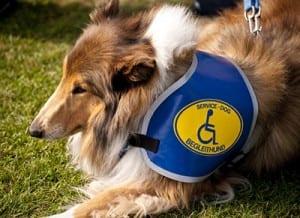
service dogFor many who suffer PTSD, dogs are invaluable. A dog can give comfort and companionship without the need to talk. They help break out of isolation and keep depression at bay.

K9s for Warriors is an organization in Ponte Vedra Beach in Florida. They specialize in rescuing dogs from shelters and training them as service dogs for military troops and veterans.

The dogs are trained to perform special tasks, such as fetching things for veterans with physical disabilities. If someone feels uncomfortable in a crowd, their dog can be taught to “cover and block” which means standing between their person and any approaching people. PTSD service dogs are unique. Some dogs excel at the job, others aren’t suited for it.

Many who don’t feel comfortable in crowds are able to trust their dog more than they trust themselves. Dogs are great observers of environment and body language, and dog often picks up on danger before a person. If a dog is relaxed, whatever danger the person perceives probably isn’t real.

Since the service dogs are rescues they come in all forms and sizes, and the person needing a dog is matched with one that will be suited for his or her needs. A tall person uncomfortable in crowds will need a taller service dog than a shorter person. The dogs are also trained to perform different tasks, and the organization strive to match the exact right dog with the right person.

Training one service dog costs around $10,000, and K9s for warriors are funded solely by private donations.

PTSD is not about what is wrong with a person; it is about what happened to a person. Everyone can help through showing common sense and respect. Don’t insist that your children be allowed to touch a service dog. If a person shies away from you, it might not be because he or she doesn’t like you; something in the past can have made the person sensitive to touch.

If you want to learn more about PTSD and service dogs, visit K9s for warriors. You can also read more at the National Center for PTSD.

Border Collie rescue works at MacDill Air Force Base in Florida

MacDill Air Force Base is located right outside Tampa, Florida. The area has large numbers of birds, which don’t go well together with the massive KC-135 aircraft that take off and land on a daily basis; a bird strike can cause serious damage to an engine, and cost large amounts of taxpayer dollars to repair. 

The air force base has found an innovative solution. They employ Sonic – a border collie rescue dog – to keep the runways clear of birds, and she performs this duty on a daily basis. Sonic doesn’t hurt the birds, but scares them off, and does so more efficiently than more high-tech options.


Oregon police dog training meeting

Police dog training is rough, as are their jobs. They climb metal stairs in the dark, crawl through narrow tunnels, physically fight people when needed, and still have to be gentle enough to approach victims. 

There was recently a police dog training meet in Oregon. To be certified, a dog needs to score 100 percent in a series of tests. That level of perfection requires around 200 hours for a drug dog, trained to sniff out drugs hidden in secret compartments, and around 360 hours for a patrol dog. The latter have physically tough jobs, are trained to track humans, and even sniff down objects a certain person has touched.

Many trainers use commands in another language, to make it easier for the dog to understand if a word is a command to do something, or said/shouted to a suspect. Many also uses different types of toys at home and as reward at work, to make it easier for the dog to know when it’s on duty.

What is an emotional support dog?

dog smallAn emotional support dog helps individuals by providing comfort and support. Many fill a need by providing affection, companionship, emotional comfort, and support. They can have special training, but that is not strictly necessary. 
Many confuse emotional support dogs with psychiatric service dogs, but it’s not the same thing. The emotional support dog does not require special training, but the psychiatric service dogs are trained to provide specific services. They for instance do room searches or turn on lights for a person with PTSD, provide counterbalance, block persons experiencing a dissociative episode from walking into danger, and so on.

Emotional support dogs provide their handlers with relief from isolation, daily structure, an increased sense of self-esteem and purpose, motivation, and many other important things.

These dogs are not covered under the Americans with Disabilities Act, but they are covered under the Fair Housing Act and Air Carrier Access Act.


What is a therapy dog?

A therapy dog is trained to provide affection and comfort to people in need. These are often pets who have undergone special training to accompany their owners to hospitals, retirement homes, nursing homes, and many other areas. Some live in a facility, and some are specially trained to work as comfort dogs at disaster areas. 

A great example of comfort dogs is the 9-11 disaster where 318 dogs and their handlers worked around the clock.

There are three basic kinds of therapy dogs:

Therapeutic visitation dogs visit hospitals, nursing homes, and other places where a visiting dog can comfort and motivate people. These are often volunteers.

Animal assisted therapy dogs assist therapists with physical and occupational therapy. They often work in rehabilitation facilities.

Facility therapy dogs live in a facility, often a nursing home, and are trained to help patients with Alzheimer’s and similar.

In many areas therapy dogs must pass the Canine Good Citizen Test. There is also a therapy dog certification test. Therapy dogs and their handlers are not covered by the Americans with Disabilities Act.

There is an important difference between therapy dogs and assistance dogs: while assistance dogs should be left alone to perform their job, people are encouraged to approach and pet therapy dogs.

Different types of assistance dogs

Dogs perform many important functions in society, and there are many different kinds of working dogs. Assistance dogs enhances people’s lives through helping with tasks their person would have trouble completing on their own.

service dogAssistance dogs are divided into three categories:

Guide dogs  help the blind and visually impaired. These dogs help humans through guiding their handler past obstacles, stopping at stabs and curbs, and negotiating traffic. The handler gives commands, but it is the dog’s responsibility to ensure the team’s safety.

This type of job can be difficult and requires a lot from the dog, because doing the job to keep the handler safe can require disobeying direct commands.

Hearing dogs  help the deaf and heard of hearing. They assist through alerting their handlers to sound, and are trained to make physical contact with their handler, leading them to the source of the sound. These dogs are commonly trained to react to doorbells, alarm clocks, telephones, crying babies, and similar.

Service dogs  help people with other types of disabilities. Some are trained to work with wheelchairs, some are medical alert dogs, others help children with autism. There is a wide range of task performed by service dogs and they are often trained to open and close doors, turn on lights, bring objects, provide balance, and many other things.

Assistance groups are recognized by the ADA. Their handler have the right to bring them to any place that is open to the public

PTSD amongst military dogs

Amongst 650 military dogs deployed with American combat forces nearly five percent came down with symptoms of Post Traumatic Stress Disorder. These dogs have been subjected to gunfire, explosions, and other combat scenarios, and react just like humans do.

Military veterinarians say it can show through dogs becoming clingy or aggressive, they might refuse to enter areas where they used to be comfortable, or become hyper-vigilent and set off alarms whether there’s something to worry about or not.

Dogs affected should be taken off their patrol duty, given lots of exercise, play time, and gentle obedience training.

Another similarity with humans is that dogs don’t have to go to war to enter a state of extreme stress. Other causes for PTSD in both species are natural disasters, car accidents, and physical or emotional trauma.

If you want to read more about dogs with PTSD, these websites provide a good starting point:

Dogs around the world – training for the Swedish defense

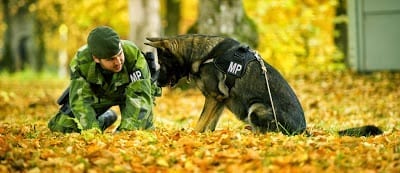
Dogs perform important jobs all over the world, not just for individuals but also for organizations such as military and police. The website forsvarsmakten.se – the Swedish armed forces – gives a glimpse into breeding and training dogs for the Swedish defense.

Swedish military dogs assist with everything from patrolling to searching for explosives or missing persons. It is a big country area-wise but has a small population, and the same facility breeds and trains dogs for both the military and police.

Every year, selected dogs produce 35 to 40 litters of German Shepherd puppies. This sounds like a lot of dogs, but it is important to note that Sweden doesn’t have the same problem with overpopulation of dogs as for instance the USA.

Sixteen people work full time with planning the breeding, caring for the dogs, finding foster homes, and other tasks involved with the dogs. The most suitable puppies from each litter are chosen and go to foster homes when they’re between eight and ten weeks old. They stay in their foster home until they’re a year and a half.

Don’t worry; the puppies not chosen for service are placed in good homes.

At eighteen months, the dogs are considered old enough to go through a suitability test. This test makes sure the dog is stable and mentally suited to perform at the level needed. Every year around 250 dogs go through the test, and around 60 move on to training.

Most of the dogs that don’t get approved stay with their foster homes, or go to another good home. There are more people wanting dogs than dogs available.

Swedish army dog