Pet feeding tips for Thanksgiving

contestThis is a great season for family get-togethers, and everyone enjoys the Thanksgiving dinner table. Make sure the holiday flows smoothly and safely for the pets too with our handy tips.

Dogs and cats can nibble on some boneless and well cooked turkey. They shouldn’t have raw turkey, undercooked turkey, skin, or bones. It is also okay to share some unsalted and unbuttered vegetables.

Dogs and cats cannot eat onions, garlic, leeks, or scallions. They also shouldn’t have grapes or raisins.

A taste of mashed potatoes is fine. Just consider that mashed potatoes can contain other ingredients than just potatoes. If your pet is lactose intolerant, cheese, butter, and milk in mashed potatoes can cause problems.

A taste of macaroni and cheese is also fine, if your pet can handle dairy.

Cranberry sauce is fine for pets, but there can be a lot of sugar in it, so limit the amount.

Some other things to watch out for are xylitol, sage (common in stuffing), and raw bread dough. The bread dough seems harmless, but it will continue to expand when eaten, and this can be very dangerous

Lost New Mexico cat found in Maine

Spice is a cat from New Mexico who bolted from her home when her human opened the door for trick-or-treaters on Halloween. The kitty didn’t return home, and she was nowhere to be found. That is, until she showed in in Maine a few days later – 2,500 miles away.

Spice was found in a duffle bag with food and kitty litter, and when she was turned in to an animal refuge they tracked her owner down through the microchip.

Spice is currently being treated for a mild respiratory infection, and a Maine businessman has promised to pay the cat’s transportation cost back to New Mexico. Hopes are, she’ll be home for the holidays.

//youtu.be/cIgWTW8aRHI

The Bengal – a big cat in small format

Bengal catMany people are attracted to big cats, and their beauty, strength, and independence holds an irresistible allure. Lions, tigers, cheetahs, and bobcats don’t make good pets, but that hasn’t stopped people from trying, and the Bengal was developed to create a cat with the wild look in a safe and domestic package. The first Bengals were bred in the 1960s, and come from small Asian Leopard Cats and domestic shorthairs. 

The typical Bengal is extremely intelligent, active, and curious, and these cats want a lot of interaction and attention. Translated to dog people, a Bengal cat is like a Border Collie in cat shape – if not properly stimulated the Bengal will get bored, and they’re quite able to open drawers and cabinets to see what’s inside, or dismantle things to see how they work.

Bengals love to climb – the higher the better – and they love playing with water. Don’t be surprised if your Bengal wants to join you in the shower. Unlike many other cat breeds, Bengals like to learn tricks and games, and enjoy puzzle games.

Each cat is an individual, but the average Bengal gets along fine with dogs. They are affectionate, energetic, and overall healthy.

Like cats and dogs?

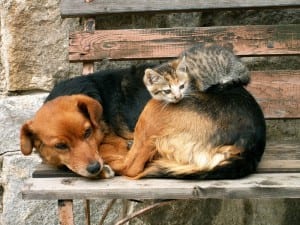
catanddogMany believe that dogs and cats are natural enemies. That’s not true – whether a cat and a dog will get along or not depends on the individuals, but also on the socialization they’ve received earlier in life. Many cats and dogs are great friends.

Whether your cat and dog will get along or not usually depends on the dog. Many dogs will chase small animals that run, and this is particularly a problem amongst herding breeds and those with strong prey instinct. Of course, the cat won’t appreciate being chased, and the more kitty runs, the more the dog will give chase.

  • Make sure the cat can get away and hide if it wants to. It’s great to give kitty access to an elevated resting place the dog can’t reach.
  • Keep your dog restrained during introductions. He or she shouldn’t be able to chase, even if the cat runs.
  • Baby gates are a great way to gradually introduce dogs and cats.
  • Let them take their time.

Don’t force physical closeness. If you pick up the cat and hold it in the dog’s face to introduce them, odds are the cat will scratch the dog, and the dog won’t like the cat. Let introductions be slow and supervised, and watch for any potential problems.

It can take weeks for a cat and dog to get used to each other, and to learn to communicate.  If they don’t seem to tolerate each other even after a few weeks, consider seeking help from a professional trainer.

Keep your cat safe today

Black catHalloween is a favorite holiday for many humans, but it also brings a number of dangers for pets. Here are five tips for keeping your cats safe:

1. Keep black cats indoors.

This is a time of the year when superstition runs high. Some people are outright cruel to black cats, and others are just thoughtless. This has escalated to a point where some shelters won’t adopt out black cats during the month of October. It also happens that people take black cats indoors as a neat decoration, not giving a second thought to the cat’s wellbeing or home. Keep your black cat indoors until the holiday is over.

It is also wise to confine cats. Ringing doorbells, people shouting “trick or treat” and the front door repeatedly opening and closing can be scary to a cat. It’s better to keep kitty locked in a back room than a panicked cat rushing through the door.

2. Hang decorations high

Candy wrappers, tinsel, and decoration are irresistible to cats. Keep decorations out of reach and throw all candy wrappers away at once. Cats might not immediately want to eat wrappers, but if they play with them they might accidentally ingest one anyway. Wrappers and tinsel can cause intestinal blockage and require surgery.

3. Keep human candy out of reach

Human candy is bad for cats and dogs. Chocolate, xylitol, and other substances that we enjoy are highly toxic to pets. Also watch out with the carved pumpkin. Unsweetened canned pumpkin is great for pets, but the carved pumpkin that’s been on the porch for days can be rife with bacteria.

4. Be careful with candles

There are many fun and cute Halloween candles. Don’t keep lit candles in the same room as the cat – cats and fire make a recipe for disaster.

5. Watch out for electric cords

Many halloween decorations come with lights, and electric cords can seem like a lot of fun to a cat. Chewing on cords can cause electrocution and burns. Also keep batteries out of reach and sight. Cats love to swat batteries around, but that game can get really dangerous if they bite they battery.

Stay safe, and Happy Halloween!

Will you celebrate cat day?

Cats have personalities just like peopleToday is cat day – a day dedicated to the celebration, worship, and adoration of cats. If you have a cat, today is a great day to spend some extra time with your feline friends. If you don’t have a cat, there are many waiting for adoption in shelters and rescues around the country, and cat day might be a good excuse to welcome a kitty home.

The Cat Fancier’s Association has made a list of most popular cat breeds. The number one spot has been held by the Persian cat for over 30 years! Here is the top five:

1. Persian

This breed is named after its home country – Persia. (Today’s Iran.) They are known for being friendly and calm, and make great indoor cats.

2. Exotic Shorthair

These cats almost look like teddy bears. They are easy-going, affectionate, and generally get along well with other pets.

3. Maine Coon

This is one of the oldest breeds from the USA and it is known for its fantastic hunting abilities. It was bred as a working cat able to withstand harsh wether. Main Coons are generally friendly, love children, and love water.

4. Ragdoll

The Ragdoll was developed to be a companion, and these cats love being near their humans. They are large, sturdy, and have bright blue eyes.

5. British Shorthair

The British Shorthair are calm and affectionate. They generally go along well with other pets, but they dislike being carried.

Are there hypoallergenic cats?

Russian Blue
The Russian Blue produces little allergens

Many believe that a cat or dog breed being hypoallergenic means they can’t cause allergies. That’s not entirely accurate – hypoallergenic means that something has a smaller risk of causing allergies, but it can still happen. There are no non-allergenic cats or dogs, but there are hypoallergenic cats breeds.

Many also believe that allergies are connected to the cat’s coat, but that’s not always the case either. Most people are allergic against proteins from the cat’s skin oils and saliva. These proteins are in turn distributed on shed fur. This means that some cat breeds – with fur – are gentler for persons with allergies than others.

The Balinese is a good example. These cats are sometimes called the “longhaired Siamese,” but despite their coat they produce little of the protein that causes allergies. This is also true for the Russian Blue and the heavily coated Siberian.

Bengals certainly aren’t hairless, and they produce just as much of the protein as many other breeds, but their coat is so fine that they don’t have to groom themselves as much as other cats. That means their hair carries less of the protein. Another upside of the Bengal is that they shed little, so what allergens are present won’t be spread around as much as with other breeds.

Cornish Rex is another breed that works well for many with allergies. They’re not entirely hairless, but they only have an undercoat. Since they’re less hairy than other breeds they also shed less, and cause less allergies.

The Sphynx cat is completely hairless. They have no fur that can trap allergens and shed around the house, and the allergy-causing substances stick to the cat.

Australian cat bumps up house price

Real estate agents see and hear a lot of things, but Australian cat Tiffany might still be something new. Or rather, the commotion around her. 

Tiffany’s owners sold their home on an auction, and the top bid came in at $2,060,000 Australian. The top bidders had an unusual request; their daughter fell in love with Tiffany when touring the house and they offered to raise their bid with $140,000 Australian if Tiffany would come with the house.

The owner’s 19 year old son is not happy about losing his pet. Thus far, Tiffany herself hasn’t voiced an opinion.

Maintain the litter box

maine coon catCats are naturally clean and hate dirty, stinky litter boxes. If the box isn’t squeaky clean, your kitty might search for a substitute, and whether that’s a corner of the carpet or a basket of clean clothes, you don’t want it to happen.

If the litter box is squeaky clean and your cat still avoids it, consider seeing a vet – it might be a sign of a physical problem.

The box itself

Some cats are picky about the box itself. It needs to be large enough to scratch, dig, and turn around in – and it has to be easy to get in and out. Many cats don’t like covered litter boxes, because they trap the smell. Cats have 14 times the sense of scent we do, and they don’t want to smell their own waste any more than we do.

Many cats get along fine with automatic litter boxes, but others don’t like them at all. In that case, a large plastic box scooped manually a couple of days is the best choice, even though it requires work.

A box for each cat

Many multi-cat households only have one box, and this can also lead to problems. A rule of thumb is one box for each cat, and maybe one extra. It’s okay to have the boxes side by side.

The litter

Some people like to use a liner in the box. That’s a personal preference – the cats usually don’t care. Most litter manufacturers recommend using 2″ to 3″ of litter, but if you have a deep scratcher you might want to use up to 4″. It’s easiest to use clumping litter, because it’s easy to scoop.

Pick a scoop that fits your litter – large particle litter requires larger holes to sift the clean litter out, while fine-grained litter needs smaller holes.

The box should be scooped at least twice a day.

Clean the box

Regular scooping and replacing the litter will keep the box clean and smelling fresh for quite a while, but eventually you’ll need to empty it and clean it. Depending on the type of litter you use this might need to be done weekly, or monthly. If you don’t like the smell, you cats won’t like it either.

Wash the empty box thoroughly with hot water and detergent. Rinse well and spray with a mild bleach solution. Make sure you don’t use a cleaner with ammonia, because this smells a little like a cat’s pee, and might make them avoid the box.

What would it be like to be a cat?

Black catHave you ever wondered why it would be like to be a cat?
While no one can truly experience the world like another species does, here are some highlights of the differences between humans and cats.

A cat’s vision is quite different from a human’s. Cats see colors, but not in the same way we do, and the muted colors make it easier for them to see movement. They also see well in light conditions that would render a human virtually blind.

On the other hand they can’t focus on anything that’s closer than a foot away, and they use their whiskers for detecting objects close the their bodies.

Cats also move quite differently from humans. They have a unique skeletal structure that lets them scale vertical walls, balance on the top of fences, and land on their feet. Their posture allows them to move quietly as well as absorbing the shock of falling from heights many time their size. In addition to all this, their back legs work almost like springs and can propel them upwards and forwards at great speed.

The cats’ ears are also different from a human’s. They can rotate their ears independently up to 180 degrees, and they can hear a wider range of sounds than we can. A cat with normal hearing can detect 11 octaves, which is two more than a human and even more than a dog. They also have a much larger number of neurons between the ear and the brain than most other mammals, so they can decipher all this information quickly.

So, what about the sense of smell? A cat has a sense of smell at least 100 times better than a human, and it can distinguish between thousands of smells. They also have a secondary scent organ above the roof of their mouths to help them detect odors when they breathe.

Science shows how much we love our pets

People love their pets. Coming home to the waiting cat or dog can be the highlight of the day, and many experience separation anxiety if they have to leave their pet for an extended period of time. A new study shows there is a biological explanation to our connection to pets.

The study compared MRI scans of brains of mothers looking at images of their dogs and images of their own children. Both types of images activate the same areas of the brain – with two differences: the photo of the child activated a region associated with forming bonds while the photo of the dog activated an area associated with facial recognition.

The next step will be to replicate the experience with men and women without children.

It is too early to conclude exactly what this means, but we already know pets are good for physical, emotional, and psychological well being. Many studies show pet owners live longer, have lower blood pressure, and get other physical advantages to non pet owners.

There are many health benefits to pets

Cat tracks down owner in nursing home

When Mrs Nancy Cowen in Westcott, England, had to move into a nursing home, she left her cat Cleo in the care of the neighbors. Normally, that would be that, but Cleo had plans of her own.

A couple of weeks after Mrs Cowen’s arrival, the staff at the nursing home noticed a friendly cat hanging around the house. The cat would sleep on benches outside the facility, and they thought she was a stray begging for food.

It took another couple of weeks before one of the carers picked the cat up in the company of Mrs Cowen, who said, “That looks like my cat. But my cat lost part of her tail in a traffic accident.”

Of course, the kitty hanging around the facility also missed a part of her tail – because she was Cleo, who miraculously managed to track down her human.

Cleo has been welcomed into the nursing home, and the staff will provide her with a loving home for the rest of her life.

Image from //www.dorkingandleatherheadadvertiser.co.uk

Pop up cat cafe in Los Angeles

Black catCat cafes originated in Asia and offer tea, coffee, food, and cat cuddling. They are extremely popular in cultures where people might not be able to have a pet themselves, and today there are cat cafes in Europe and Canada as well. Thus far, the US has lagged behind.

New York City saw a pop-up cat cafe earlier this year, but it might be Los Angeles that gets the first permanent installation. The first try starts today and will be open through October 5th 2014.

The cafe partners with no-kill shelter Best Friends Animal Society Los Angeles, and with the Chinatown Business Improvement District. There will be cats available for petting and adoption, costumed butlers, and entertainment.

Hopes are the cat cafe can become a permanent installation, and the plans include space to house homeless cats as well as showing visiting shelter cats seeking new homes. There are also plans to open cat cafes in Portland, San Francisco, and Oakland.

The dreams of a permanent NYC cat cafe might also come to fruition soon – there is currently a crowd funding campaign attempting to raise startup funding.

Read more about the pop up cat cafe here.

If your pet presses its head against the wall, it might be time to see the vet

Sometimes, not often, a cat or dog starts pressing its head against the wall or another object. The pet might even walk into a corner and seemingly not know how to get out. The head pressing is often the most notable behavior, but the pet might also show compulsive pacing, circling, changes in trained behavior, and even have seizures. If you note some or all of these symptoms, it’s time to see the vet. 

These strange behaviors indicate damage to the nervous system, or a toxic poisoning. There can be a number of underlying causes, and the sooner the pet gets to the vet, the better.

Amongst the possible causes are cancers, stroke, metabolic problems, an infection, lead poisoning, head trauma, and parasites. Treatment is imperative for the future health of your pet.

Compulsively pressing the head against a wall or other object shouldn’t be confused with playfully “head butting” their human. Head pressing is hard to miss – the behavior doesn’t look normal.

Pizza-baking cats?

It’s hard to resist pizza, and even harder to resist cats. So, why not combine the two in an advertising campaign? That’s just what Pizza Hut in Japan did, presenting a web series called Pizza Cat where all pizza is made by cats.

Stars of the show are Tencho, Hime, Dora, and Detch – four kitties wearing red caps and scarves. Cats are a big deal in Japan, where cat cafés pop up all over  to allow patrons to watch and pet cats even if they can’t have one of their own.

The Pizza Hut cats are also popular, but they don’t seem to have the delivery completely down:

//youtu.be/grOlrwgMkiQ

In this episode, it’s time to clean the restaurant. Watching a cat ride an automatic vacuum is surprisingly relaxing.

//youtu.be/A5XcshenWeU