New system might make dogs lifesavers for seniors

Beautiful lying chocolate Havanese dogDogs are sensitive to human emotions, and scientists at the Newcastle University in the UK are working on a system where elderly dog owners could benefit from dogs’ responses to our moods and behavior.

To start with, the team needs to know the dog’s normal behavior, so there’s something to compare to. They have developed a remote-sensing water proof collar that can measure what the dog does and how it acts during a normal day.

Step two is comparing changes in behavior with the baseline. Sudden changes can indicate that something has gone wrong. For example, if the dog no longer walks outdoors like it used to, the owner might have run into to issues with mobility. A sudden increase in anxiety in the dog might mean that there’s something seriously wrong with the owner.

The dogs wouldn’t need any extra training. They only have to wear the collar, and behave like dogs do. The idea is to be able to reassure family and caregivers about an older person’s health without intruding on the person’s privacy. Monitoring the pet is less intrusive than monitoring the person.

America’s pets are overweight

The Association for Pet Obesity Prevention recently presented their latest survey with sobering numbers. 54 percent of US pets are overweight. 53 percent of adult dogs and 55 percent of cats have been classified as overweight or obese, and that equals 88.4 million pets.

To make the news even more disturbing, 15 percent of cat owners and 22 percent of dog owners think their overweight pets are within normal range.

The additional weight comes from a lack of exercise, and overfeeding. It is easy to forget how small a pet is compared to a human. A typical dog biscuit fed to a 20 lbs dog is the equivalent of a person eating two double-stuffed fudge cookies. Giving a pig ear to a  40 lbs dog is the same as a person drinking six cans of soda.

Excess weight in pets often shorten the life span. It can lead to joint disease, diabetes, heart conditions, and skin disease.

Get the right size food bowlGood ideas to keep the pet’s weight under control include:

* Exercise

* Use a smaller food bowl – it’s easier to overfeed a pet when the bowl looks empty

* Use a measuring cup

* Follow feeding instructions, and check every time you change foods, because the calorie  contents might be different

* Limit the treats

Mix-and-match dogfoods give emotional reward to pet parents

contestTraditional dog food come as kibble in a bag, or stew in a can. As more and more pet parents get into cooking for their pets or feeding raw, the marketplace for dog food is also changing. According to research made by PetCo, a majority of pet owners customize their pet’s food in some way. It can be through adding vegetables or bacon to the regular meal, or through preparing it all from scratch.

Naturally, the pet industry is on top of the trend. Several  brands design food that require us to freeze, dice, heat, mix, and refrigerate the food. The food can, for example, come in a roll and be mixed with kibble and canned pumpkin. There are even customized dog foods, perfect for the individual’s breed, age, and activity level.

US sales of dog food totaled $21 billion in 2013, and is still on the rise. Some stores respond through redesigning their pet food aisles to look more like human food aisles. Several pet food makers are also rebranding their foods with recipes and names more appealing to humans.

What type of food do you give your pets? How do you make the decision?

Finnish dog breed yodels and wins barking competitions

Finnish Spitz stampThe Finnish Spitz – or Suomenpystykorva – is the national dog of Finland, hailed in many patriotic songs. These small and hardy dogs are perhaps most known for their barking abilities. They can bark up to 160 times a minute!

The Finnish Spitz was originally bred for hunting, with a focus on birds and small game, but they are also used for moose and bear. The breed stems back some 6,000 years, with the first representatives arriving to Europe around 2,000 years ago.

A typical Finnish Spitz loves children, wants to spend time with the family, and gets along well with other dogs. They are intelligent, independent, lively, quick, and friendly.

So, what’s with the barking? It has several functions; it tells the hunter the dog has found something, it distracts the prey, and to some point it masks the noise of the hunter approaching.

In their home land of Finland, there are barking competitions for the Finnish Spitz. They are also one of the few dogs who can yodel.


Tiniest working dogs in the world

The phrase “working dog” is normally associated with something big and robust. Like a German Shepherd working as a police dog, or a Labrador helping someone hard of seeing. Sometimes good things come in small packages; Lucy is a Yorkshire Terrier who recently set a Guinness World Record as the world’s smallest working dog.

Lucy weighs a mere 2.5 pounds and works as a therapy dog. She visits hospitals, nursing homes, and rehabilitation centers, and works with children with disabilities.

The previous record holder was named Momo, and that is an eight-year-old Chihuahua who works as a police search-and-rescue dog in Japan.

World’s rarest breed sings

The New Guinea Singing Dog has been called a living, breathing, furry, and four-legged fossil. This breed is believed to be the rarest in the world and was local to New Guinea until 1957 when the first dogs left the island.

Besides being rare, the dogs are also primitive in the sense that they were separated from all other dog breeds thousands – maybe even tens of thousands – years ago, and have developed virtually undisturbed.

The dogs have adapted well to living as pets. They are agile, active, graceful, and alert. They are known to be affectionate with people they know, and they are both curious and clever. Being so close to the wild, they also have a strong hunting instinct, and they require a lot of exercise. They can climb trees, jump, and dig, so any yard must be very well secured.

So, what’s with the singing?

The name comes from their melodious and distinctive howl. These dogs have a dramatic ability to vary the pitch. If they howl in a group, all the dogs will strike a different pitch. It sounds like a choir! They don’t bark a lot, but are still quite vocal.

Summer plants to watch out for

Rhododendron is poisonous to cats, dogs, and horses.Most dogs are super-curious, and summer invites to investigation. That’s usually not a problem, unless you have one of those dogs that try to eat everything, or play catch with wasps and bees.

While many dogs wouldn’t dream of tasting a plant, others munch down on everything they see. Knowing your dog’s normal behavior goes a long way towards ensuring safety.

Some of the most common problem backyard plants for dogs are Oleander, Lilies, Daffodils, Tulips, and Rhododendron. Bulb plants cause problems for dogs who like to dig, because the bulbs are often toxic – and inviting to chew on.

Common signs of a pet ingesting something poisonous include slobbering, drooling, and pawing at the mouth. Also watch out for vomiting and weakness. A poisoning left untreated can have serious consequences and even lead to the pet’s death, so it’s better to be safe than sorry with calling a vet.

If you wonder about plants, the ASPCA has a great list that includes both toxic and non-toxic plants.

Prevent dog bites

A large number of dog bites are caused by misunderstandings between humans and dogs. Here are some easy tips to help prevent dog bites.

1. Never leave a baby or small child alone with a dog, even if it is your own.

Dogs generally give many warning signals before they nip – but children and even many parents aren’t able to interpret the dog’s body language. Is the dog looking away? Turning away its head?

It seems self evident not to let a child stand on the dog, sit on the dog, pull the dog’s tail or lips, but parents still allow it, and a number of dogs are put down each year for biting children in situations that could easily have been prevented.

2. Don’t run past a dog.

Dogs love to chase and catch stuff. If you run, hunting dogs and herding dogs will want to give chase. This is another reason why children often get nipped; they behave as prey or as something that should be herded.

3. When you meet a dog, don’t bend over it or pet it on top of the head.

Crouch down next to the dog and turn away just a little. If the dog wants to approach you, he or she will come. Bending over them and petting them from above can be interpreted as a threat.

4. Treat dogs with respect

This naturally goes for both your own dog and strange dogs. Pay attention to body language. If you meet a strange dog, ask the owner if it’s okay to pet or approach, and respect a no.


The dreaded nail trim

Some dogs are fine with owners or groomers touching their feet and working on their nails. Others, not so much. Here are some simple everyday exercises that can make nail trimming and paw care easier.

1. Touch your pet often.

Sure, you pet your dog and that’s great, but make sure to touch areas you don’t usually pet as well, like the paws. If the pet seems disturbed by the touch or pulls away – assuming there isn’t an underlying medical condition – try giving a treat as you touch the area briefly and gently.  Repeat this every day until he or she “gets” it. Once the brief touch has been associated with something positive, that is, getting a treat, you can increase the time of touching before the treat.

2. Add grooming tools

Whatever the dreaded grooming tool might be – maybe nail clippers or a brush – this can also be introduced with a treat. Show the tool with the treat without trying to use it. After a while, the dog will associate the tool with treats and think it’s the best thing ever. When that happens, you can try touching the pet’s body with the tool while it’s getting a treat, and step by step, the strange and scary will be less frightening.

3.  Clip a nail

Once the pet accepts you touching its paws and the clippers, it’s time to start practicing for actually clipping a nail. Pinch a toe the way you would do if you were to actually trim the nail, release it, and give a treat. You might have to repeat this many times during a period of days or weeks. The next step is to touch the nail with the nail trimmer and give a treat. Once that is accepted, clip a nail and give a treat.

Before you know it, your pet will think that trimming nails is a great event.

Upcoming study will measure the usefulness of dogs for veterans with PTSD

The Veteran’s Affairs Department is about to conduct a study of the effectiveness of service dogs for treating post-traumatic stress disorder. The study, “Can Service Dogs Improve Activity and Quality of Life in Veterans with PTSD” will measure the impact of a service dog compared to a pet.

220 veterans will participate in the study, and are currently undergoing dog care training. They will be divided into two groups. Half will be teamed with a service dog trained to address the disability, and the other half will be teamed with an emotional support dog. The latter are pets with obedience training, but without PTSD service training.

Is there a difference?

Yes. First of all, a well trained service dog costs at least $10,000, and often up to $25,000. Service dogs are covered under the American with Disabilities Act and are allowed to accompany their human in all public spaces.

Emotional support dogs are well-trained pets that provide support and comfort. They are not covered under the ADA, but they do have some protection on commercial airlines and under the Fair Housing Act.

If there is a measurable difference between the groups, service dogs might become an accepted PTSD treatment covered by VA.

North Carolina inmates have been training dogs for 10 years

North Carolina participates in a “New Leash on Life” program, teaching inmates to train dogs. The program has been a success; working with dogs inspires compassion, patience, and teaches a possible future career. The Correctional institution also offers a vet tech program.

The dogs come from shelters, and during the past ten years, thousands of dogs have gone through the eight week program, learning basic behavior and socialization. 92 percent of dogs that has gone through the training are adopted.

Professional dog trainers volunteer, teaching the inmates, and sponsors pay for food and medical treatments.

Don’t give up on your dog when it’s a teenager

A dog is most likely to be surrendered to a shelter when it is between nine and eighteen months old. At this age dogs have grown out of the super-cute puppy stage and look like adults, but they don’t act adult, and families unprepared for this phase of life often give up. Adolescence can be as difficult for a dog as it is for a human.

Adolescent dogs are super-curious and want to discover the world with all their senses. They dig, they chew, run away to explore, jump, and challenge authority. For many, everything is a game, and their attention span is… squirrel!

On top of all this, they have so much energy it takes super-human stamina to keep up. This is when many give up, and instead of helping their dog to become a well balanced adult, they send their pet off to a shelter and probable death.

It is always important to choose a dog breed that works well for the family, but it is extra important when picking  a puppy. Some breeds get through this period in life easier than others.

Working breeds are often particularly difficult; they have a lot of energy, high intelligence, and need a job. If they don’t get something appropriate to do, they will make something up. Some working breeds – like Border Collies – are often considered adolescents up until they’re three years old, so in addition to the difficult period being more intense, it also lasts longer.

So, how do you survive, stay sane, and keep your dog?

Provide plenty of exercise. Consider crating your dog when he or she is unsupervised. Keep training the dog, and make training sessions fun. Thinking games often wear dogs out better than physical exercise. Above all, remember that this is a phase that will eventually go away.

Dog finds abandoned baby

Dogs with their keen senses can find the strangest things, and bring home everything from golf balls to half a tree. Most doggie parents would not expect what these dogs found:

February 2013, a dog found a newborn girl abandoned in a plastic grocery bag in Cypress, Texas. State law allows anyone to drop a newborn off at a hospital or fire station with no questions asked. Abandoning a child outside, on the other hand, is a crime. This incident was the third in a short period of time where children were abandoned in the area.

June 2013, a dog in Thailand went exploring on his own, and found a newborn who had been wrapped in a plastic bag and thrown into a garbage dump. Pui brought the bag home and got a medal from the Red Cross for his good deed.

October 2013, a German Shepherd found a baby in a bag in Birmingham in the UK. This baby was later named Jade after its four-legged savior.

Even when humans let each others down, dogs are our best friends!

https://www.youtube.com/watch?v=BCUq3BvDY1Q


Can you teach a dog to swim?

Labrador RetrieverAssuming the dog breed is physically able to swim – not all dogs can swim – how do they learn to do so?

Dogs will instinctively paddle when they enter water. Some dogs love water at first sight, plunge in, and might not want to come out again. Others are reluctant and even scared.

If your dog doesn’t take to swimming immediately, here are some tips that might help them along:

  • Encourage the dog by going out in the water yourself and calling for them. If they follow you, reward with praise.
  • If your dog likes to play fetch, they might follow a floating toy or tennis ball into the water. Start at a shallow depth and go gradually deeper.
  • Many dogs want to join in if they see people or other dogs having fun in the water.

As with all training it is important to stay calm. Some dogs will never like water. We might feel that they’re missing out, but should still respect it.

If your dog turns out to love swimming, it is still up to you to think of safety. Older dogs and puppies tire quickly, and they often don’t realize how tired they are until it’s too late to turn back. Watch out for strong currents and underwater debris that can ensnare the dog.

Many dogs who don’t like water still enjoy an outing to the beach. Non-swimmers should wear a life vest. This is particularly important for breeds such as Bulldogs who are physically unable to swim. If the sand is hot, protect the sensitive paws. Make sure there’s access to shade and cool drinking water, and be attentive for signs of heat stroke.

K9s for Warriors provide support dogs for military veterans with PTSD

PTSD, or Post Traumatic Stress Disorder, is most often associated with military veterans, but can affect anyone. PTSD is triggered by facing a situation “larger than oneself,” such as a car accident, home invasion, robbery, death of a loved one, natural disaster, or working in any type of medical or emergency field. These situations don’t necessarily lead to PTSD, but they can.

The symptoms are as varied as the causes, but the most common include nightmares, sleeplessness, recurring memories, irritability and anger, feeling numb, a sense of never being safe, and fearing crowds. This is difficult for the person afflicted with PTSD, of course, but also for loved ones who often have a hard time coping with personality changes and seemingly irrational behavior.

PTSD is common. Almost 8 percent of Americans will experience it at some point. The number is much higher amongst military veterans. Almost 29 percent of veterans treated at VA medical centers have the diagnosis.
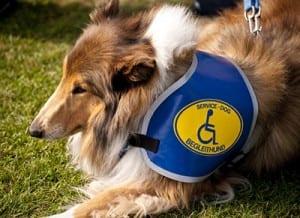
service dogFor many who suffer PTSD, dogs are invaluable. A dog can give comfort and companionship without the need to talk. They help break out of isolation and keep depression at bay.

K9s for Warriors is an organization in Ponte Vedra Beach in Florida. They specialize in rescuing dogs from shelters and training them as service dogs for military troops and veterans.

The dogs are trained to perform special tasks, such as fetching things for veterans with physical disabilities. If someone feels uncomfortable in a crowd, their dog can be taught to “cover and block” which means standing between their person and any approaching people. PTSD service dogs are unique. Some dogs excel at the job, others aren’t suited for it.

Many who don’t feel comfortable in crowds are able to trust their dog more than they trust themselves. Dogs are great observers of environment and body language, and dog often picks up on danger before a person. If a dog is relaxed, whatever danger the person perceives probably isn’t real.

Since the service dogs are rescues they come in all forms and sizes, and the person needing a dog is matched with one that will be suited for his or her needs. A tall person uncomfortable in crowds will need a taller service dog than a shorter person. The dogs are also trained to perform different tasks, and the organization strive to match the exact right dog with the right person.

Training one service dog costs around $10,000, and K9s for warriors are funded solely by private donations.

PTSD is not about what is wrong with a person; it is about what happened to a person. Everyone can help through showing common sense and respect. Don’t insist that your children be allowed to touch a service dog. If a person shies away from you, it might not be because he or she doesn’t like you; something in the past can have made the person sensitive to touch.

If you want to learn more about PTSD and service dogs, visit K9s for warriors. You can also read more at the National Center for PTSD.