Service animals and the fair housing act

Despite a plethora of federal and state laws protecting people with service animals, there’s still confusion about rights and obligations. This often leads to discrimination, and disputes between persons with service dogs and everything from landlords to restaurant owners. When it comes to housing, service animals are covered by the Fair Housing Act.

The Fair Housing Act prevents discrimination, and covers persons with disabilities in the sale, rental, or advertising of dwellings. For questions about individual cases, contact your local Housing and Urban Development (HUD) office.

In order to be protected by the Fair Housing Act, a service animal must pass the following three tests:

  1. The person must have a disability.
  2. The animal must serve a function directly related to the disability.
  3. The request to accommodate the service animal must be reasonable.

A disability is defined by the Fair Housing Act as an individual who has a physical or mental impairment that substantially limits one or more major life activities, or has a record of an impairment, or is regarded as having an impairment. The disability doesn’t have to be obvious.

The act covers most types of housing, but there are limited exceptions for single family homes sold or rented by an individual owner.

To learn more about this, visit Pet Partners’ page about service animals and housing.

Endurance in the dog world

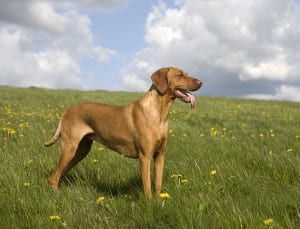
Vizsla, a Hungarian dog breedDogs have many wonderful traits and enrich human life in many ways. While many breeds prefer to lounge on the sofa, some are workaholics and possess extraordinary endurance.

Many breeds love sports. Here are three breeds that might not immediately come to mind, but could be perfect if you seek a partner that will keep up with you all day.

Border Collie

The Border Collie is not an easy breed, or well suited for a first-time dog owner living in an apartment. However, if you’re looking for a smart and agile partner that can keep up with running, swimming, and jumping through the day every day, the Border Collie might be perfect.

This breed constantly tops lists of dog intelligence. This isn’t just because they’re trainable and eager to please; they are quite independent and able to make their own decisions. They are designed to move quickly, can turn on a pinhead, and keep a pace of around 30 mph. A herding Border Collie can run 50 miles every day and still have energy left to protect the herd.

Downsides? Border Collies get bored easily and need something to do. If they don’t have a task they tend to invent one.

Huskies

The Siberian Husky, Alaskan Husky, and similar breeds are able to travel long distances while pulling or carrying a burden. They can be goofy and funny, and are bred for speed and endurance. An Alaskan Husky can, for instance, run around 28 mph. In teams they pull sleighs for hours with an average speed of 10 mph. Think marathon runners created to deliver goods and supplies to remote areas.

The Alaskan Malamute isn’t exactly a Husky, but they possess many of the same qualities – they were bred to haul heavy loads over distance.

All these breeds are intelligent, independent, and can be stubborn.

Vizsla

This is a powerful and versatile Hungarian hunting dog. They are easy to train, affectionate, fantastic runners, and amazing swimmers. Vizslas excel at all sports. If you want a companion for hiking, running, playing ball, or agility, this might be the perfect dog.

A Vizsla thrives as part of an active family – they’re not happy left alone. They have a can-do attitude, as long as whatever they’re asked to do involves their human. These dogs require large amounts of exercise, but are also known for being gentle and tightly bonded with their family.


Dogs can get jealous

Many dog owners are convinced their dogs get jealous, while some people say it’s just imagination – projecting a human emotion on the dog. Scientists recently made an experiment to ascertain which is correct.

The test adapted a test used for human babies. 36 dogs and their families participated, and the owners were asked to shower a robotic stuffed dog with affection, pay attention to a plastic jack-o-lantern pail as if it were a dog, and to read a book aloud. The pail and the book were compared to the robotic dog to see if there’s a difference in behavior between something that looks and acts like a dog – the robot barked and wagged its tail – and something that’s clearly not.

To make the experiment fair, the robot would have to be lifelike enough to be accepted as an actual dog. 86 percent of the participating pooches attempted to greet it like they would a dog, and were probably surprised when the rear end held no smell…

The results were clear. The dogs were twice as likely to touch or push their owner when he or she paid attention to the robodog than when playing with pail. A full 78 percent pushed and touched in response to the impostor dog. 42 percent reacted that way with the jack-o-lantern, and 22 percent when their human read the book.

It becomes even more interesting. One fourth of dogs snapped at the robot, and one third tried to place themselves between the robot and their owner.

Conclusion? Dogs definitely get jealous. It’s not your imagination.

How does a doggie DNA test work?

It is possible to ascertain a dog's breed through DNA analysisIt’s easy to know what breed a dog belongs to if it comes with a pedigree. Some shelter pets can show their heritage, but most are completely without papers, whether they’re purebreds or mutts. Many dog owners would still love to know what their dog is, and science has given us the doggie DNA test.

A canine DNA test starts with ordering a kit to take a cheek-swab from your dog. This sample is sent to a research-company where it is compared to a database with DNA samples from different breeds, and the answer comes back in a few weeks.

The DNA of the original dogs would have been pretty similar, but over time genetic mutations have given birth to the breeds we have today. The differences can be seen in DNA, and form the base of breed DNA testing.

The analysis is fairly accurate in mutts with a purebred parent or grandparent, but some purebred dogs can also be difficult to ascertain. Some breeds are closely related, and some breeds are derived from another still in existence.

Many DNA reports also give in-depth explanations of a dog’s unique behaviors, personality traits, and wellness needs.

Why do some dogs love to have their tummies rubbed?

Some types of doggie behavior can be puzzling to us humans. Like, what’s up with the tummy rub? And why are dogs so fascinated with sniffing each other’s butts? 

The belly scratch

Not all dogs like to have their bellies rubbed, but many of those who do really cherish it. There are several theories to why.

Dogs generally don’t show their stomach to other dogs – unless in a sign of submission – and assuming they don’t do it of fear, showing their tummies to us shows trust. The tummy rub becomes a way of bonding.

On top of this, the stomach can be difficult to reach with the paws, and the skin there is sensitive. A good tummy rub with human fingers probably feels better than their own nails.

The butt smelling

If a human was to approach from behind and smell another person’s butt we’d find it peculiar to say the least. In the doggie world, this approach avoids challenging someone by facing them head-on. The tail-end of the dog also gives off pheromones that can be read by other dogs. By sniffing the behind, a dog can learn about sex, reproductive, and social status.


Five of the world’s largest dog breeds

Many like small dog breeds, because they are convenient. A small dog doesn’t require as much space as a big dog, smaller dogs eat less than big ones, and so on. But, there is something special about the gigantic dogs, like Newfoundlands, Irish Wolfhounds, and Mastiffs. Here is a list with five of the world’s largest dog breeds.

The Irish Wolfhound
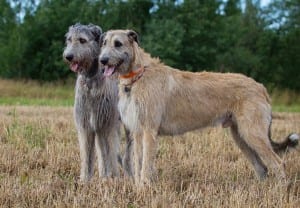
An Irish Wolfhound requires an extra large PlexiDor dog doorThis is a friendly giant. The breed is not currently record holder for world’s tallest dog, but if one were to take an average of individuals in a breed they would be the tallest. They are excessively friendly towards people and don’t do good jobs as guard dogs. If a burglar were to enter the house and carry off some things the Irish Wolfhound would probably consider the intruder a new best friend. However, if the family is physically attacked, an Irish Wolfhound will defend its people.

They are patient and generally good with children. While they take to urban living pretty well, they require a lot of exercise.

The Great Dane
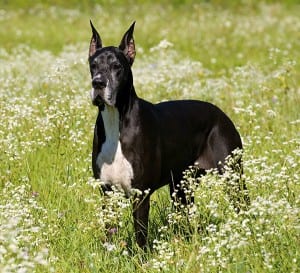
A Great Dane needs an extra large dog door
A Great Dane currently holds the position of world’s tallest dog. They are generally very friendly and get along with people, other dogs, and other types of pets. Great Danes are strong, elegant, friendly, and energetic. The earliest drawings resembling the breed stem back to around 3,000 BC, and the oldest written description of them can be found in literature of 1121 BC.

The English Mastiff
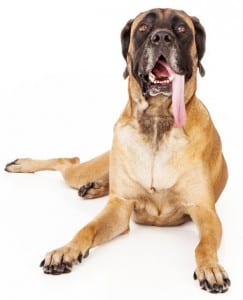
An English Mastiff requires an extra large PlexiDor dog doorThe Great Dane and Irish Wolfhound might compete about being the tallest dogs on the planet, but the English Mastiff is definitely the heaviest. A male can weigh up to 250 lbs, and the breed is considered the oldest in the UK.

English Mastiffs make wonderful and devoted pets. They are generally very good with children and other dogs, but they tend to be lazy and needs to be activated in order to get enough exercise.

The Leonberger
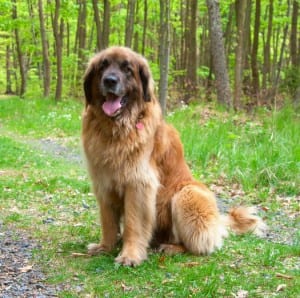
A Leonberger requires an extra large PlexiDor dog door.The Leonberger is extremely popular in Europe, maybe a bit less so in the USA. They are even-tempered, unfazed by most things, and become deeply attached to their humans. They are also very agile for their size, and require lots of exercise.

Leonbergers can be very energetic when they grow up, but generally settle down around the age of three and becomes gentle giants.

The Scottish Deerhound
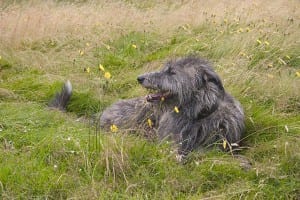
A Scottish Deerhound requires an extra large PlexiDor dog doorThis is the least commonly known breed on the list, and looks somewhat like a long-haired greyhound. The history of the breed has been traced back to pre-Roman times, and they are very popular in their home country.

A Scottish Deerhound is about the friendliest animal on the planet. They are eager to please, gentle, and loving. However, they get bored easily and require plenty of exercise and something to do. They are happiest in pairs, and keeping two together can alleviate many of the boredom problems.


Can a giant dog have a dog door?

Absolutely. There is a PlexiDor dog door for even very big dogs.

The extra large PlexiDor is constructed to stand up to these large and powerful dogs, even if they go through the door at a full run. The dog door handles dogs approximately up to 220 lbs. If you’re in doubt, contact customer service and they will be happy to help you pick the right solution for your needs
Seven ways you can help a shelter or rescue

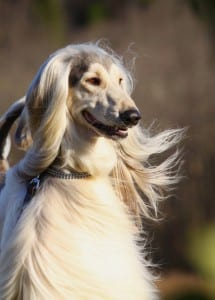
Most Afghan Hounds do well with a Large PlexiDor Dog DoorMost people want to help homeless animals, but it can be hard to know where to begin. Not everyone can send money, and money itself doesn’t solve all problems. Here are some ideas on how to help a shelter or rescue – and being able to help save animals – without breaking the bank.
Volunteering is rewarding and appreciated. Many shelters need help with caring for the animals. Some need help with cleaning, others with socializing pets. There’s usually something to do. Contact your local shelter or rescue group and see if they need help.

Another great idea is donating your skills. Maybe you’re a great photographer, good with computers, or know how to edit videos. Good photos and videos of shelter pets help them get exposure, and can make the difference between a pet finding a new home or staying in the shelter.

Donate gently used items. Most shelters and rescues always need extra supplies. Contact them first to see what they need, and clean any supplies before taking them over. Many shelters and rescues ask for towels, blanket, pet beds, water and food bowls, toys, collars and leashes, and brushes.

Many shelters and rescues also ask for household items. Common items on the wish list include cleaning supplies, old newspapers, paper towels, and office supplies. Call and ask them what they need before going over.

Foster a cat or dog. Rescues are always looking for fosters. Some pets need a place to stay overnight, others for weeks or even months. It is a rewarding experience that saves a life.

You can also donate pet food and litter. Shelters and rescue groups go through enormous amounts of pet food and cat litter. You can actually enter to win 1,000 lbs of dog food right here, and donate to your favorite rescue – the contest is open until November 30, 2014.

If you’re throwing a big party, getting married, or have an upcoming birthday, you can donate part of your event registry. It is a rewarding experience that makes everyone feel good.

And naturally, if you’re thinking of adding a new friend to your home, consider adopting a shelter pets. There are all sorts of pets waiting for new homes. Petfinder.com lets you search for available pets in your area.

Store employees make home make wheelchair for paralyzed dog

Wally is a Tampa Bay rat terrier who recently suffered a stint of bad luck. His human, Rebecca Pierce, dropped him off at their vet’s kennel service for a quick trip out of town, and came back to find Wally’s back legs paralyzed.

The vet believes Wally has a herniated disc in his spine, and poor Wally uses his front paws to get around, dragging his legs behind him.

Clearly, Wally needed help while the vet worked on figuring out both what happened and whether the condition can be reversed. Pierce saw videos of people making their own pet wheelchairs, and brought Wally to Home Depot, hoping to find material to build something for her pup.

Little did she expect to meet guardian angels dressed in orange aprons: two of the store employees spent hours building a perfect wheelchair. To make things even better, the store management decided to cover the cost.

Wally is seeing a doggie chiropractor and he is regaining strength in his legs, but it will take a while for him to walk again.

Read more of the story here.

Five fun trivia-facts about dogs you don’t know

Most people know something about dogs, and if you have found your way to the PlexiDor page you probably know a lot about them. Besides being good company, they make excellent conversation starters. Here are five fun trivia-facts about dogs you might not know.

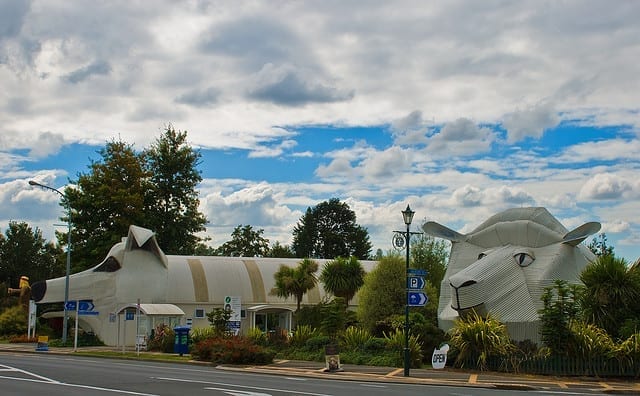
5. New Zealand town has buildings shaped as sheep and dogs

Tirau is a small town on New Zealand’s north island. The town was traditionally a farming community, but has started to make money as a tourist attraction. They have a tradition of using old, discarded, corrugated iron to create art, and they have a craft store shaped as a sheep along with an information center shaped like a dog.

Sheep and dog building, image from strange buildings.
4. Who cleans up after a seeing eye dog?

These dogs are highly trained professionals. They guide their handler through complex environments, traffic, and more. They only do their business on command, and the males are taught not to lift their leg when peeing. This makes it possible for a handler to pet the dog once it’s doing its stuff and figure out what’s going on. If the dog’s back is rounded, cleanup will be required.

3. Seeing eye dog was first dog to become a “Million Miler”

Speaking of seeing eye dogs, service dogs are allowed everywhere open to the public. That includes planes. Nesbit was a seeing eye dog who earned over one million Delta airline miles in his life. He even had his own frequent flier card.

2. Stray dogs in Afghanistan saved 50 soldiers

The troops made friends with a few stray dogs, and when a suicide bomber tried to enter the soldiers’ quarters to kill the 50 men inside, the dogs attacked. One of the dogs was killed in the incident, but the others were celebrated as heroes. It turned out to be pretty expensive and difficult to bring the dogs to the US, so a Facebook group raised $21,000 to fly the dogs to America.

1. The average dog knows math

Most dog owners think their pooches are smart, but few people know exactly how smart. One Border Collie understands a vocabulary of over 1,000 words, and has shown a grasp of grammar. The average dog can understand up to 250 words and gestures, can count at least up to five, and perform simple mathematical calculations.

Bonus trivia: 

While pet “holes” have existed almost as long as cats and dogs have accompanied humans, Sir Isaac Newton is credited with inventing the modern pet door.

Secondhand smoke harmful to pets

While no one has measured exactly how many pets die from secondhand smoke each year, vets know from lab tests and office visits that inhaling smoke causes cancers, allergic reactions, and inflammations in pets.

Several schools, including Tufts University’s School of Veterinary Medicine in Massachusetts and Colorado State University have studied the connection between secondhand smoke and cancer in pets. The results are discouraging; breathing in smoke can cause malignant lymphoma in cats, lung and nasal cancer in dogs, and various respiratory problems in both species.

Dogs are susceptible to smoke, but cats even more so, and it is important to make pet homes smoke free. Lymphoma is one of the leading causes of death in cats. Repeated exposure to smoke doubles a cat’s risk of getting cancer. Living with a smoker for five years or more quadruples the risk.

Symptoms of cancer include coughing, problems breathing or eating, excessive drooling, weight loss, nasal discharge, vomiting, and bleeding and sneezing. Cancer kills more dogs and cats than any other disease.

If you’re trying to quit smoking and turn to e-cigarettes, be careful how you store your cigarettes and accessories. Dogs are attracted to nicotine cartridges from e-cigarettes and can take them out of the trash. Make sure to store all parts of the cigarette along with any fluids used out of reach of pets and children.

How to take good shelter photos

AidiAll shelters and rescues need photos of available pets. A few are fortunate enough to have professional photographers donate time to help, but the vast majority rely on volunteers. This photo can be the most important event in the life of a shelter pet – it is literally a matter of life and death.
The shelter photo will show the pet on the shelter’s website, on Petfinder, Facebook, and other online resources. It’s the pet’s lifeline, in many cases their only hope of finding a new home. At the same time, the animals are stressed, and you’re usually working with low-budget equipment.

Take your time

The shelter crew is often stressed, and it seems like a good idea to get photos of as many pets as possible in the shortest possible time. However, spending just a few minutes with each pet will make the photos so much better, and might very well decrease the amount of time the pet will have to spend at the shelter.

Spend at least 5-10 minutes with a dog, and even 15 with a cat. They need to transition mentally between being in the kennel and being with you.

Find a good spot

If at all possible, take photos of dogs outside. They’ll need a few minutes to explore before they’ll be willing to cooperate. If it’s bright and sunny, shoot in the shade. If you have to take photos indoors, try to find a good backdrop. Anything is better than the kennel. There might be a nice wall or something you can use.

Take many photos

With digital technology it’s possible to take many photos in a short period of time without extra cost. Pets are difficult to photograph because they move all the time. If you take many photos, the chance of one being great is much bigger than taking one and hoping it will be fantastic.

Don’t use the flash

Many good photos of dogs and cats have been ruined by using the flash. It can scare them, and the flash reflecting from their eyes or shiny coats can make them look like a pet belonging to Dracula. It’s also helpful not to hold the camera in front of your face. The pets will trust you more, and relax better, if they can see your face.

Talk to the pets

When it comes to dogs, you want to get them from “I’m in jail” to “This person likes me.” Talk to them in a cheerful voice. Shelter kitties can be skittish, and here a happy but soothing voice works better. Keep talking. If they can connect with you they might be able to relax a bit, and photo with happy ears or even a smile sells much better than a sad shape crouched in a corner.


Secrets your pets wish they could tell you

shutterstock_1519023_catanddogIf cats and dogs could speak, they’d probably give us some hints on things we can do better. Cat and dog owners do their best, but it would be easier if our loved furry friends could give us some hints. Here are some examples on areas where we could improve.
Many cat-owners play with a laser pointer. Have you noticed your cat might seem frustrated after the game? Cats live to hunt, and if you end the game with pointing at an actual toy, the cat might get to “catch and kill” it.

Many dog owners get frustrated with their pooches during walkie-time – it’s difficult for a human to understand why the dog must walk around in circles before doing its business. Especially frustrating when it’s cold or raining, right! Dogs have an instinct to be aligned with the earth’s magnetic field before they do what they need to. Science have yet to figure out why.

Too much nap time can affect a pet’s personality. Many behavioral problems can be solved by taking a longer walk or giving some more play time.

All dog food is the same, right? Not really. There is special food for puppies, enforced with the nutrition a growing body needs. There is also special food for seniors, formulated to keep old dogs healthy.

Subtle changes in a pet’s behavior might mean it’s time to go to the vet. They can’t tell us how they’re feeling, and both cats and dogs are experts at hiding illness. Watch out for changes such as eating slower, drinking more, or getting tired quicker than usual. It might be time for a check-up.

And, if your dog isn’t paying attention during training, you might want to switch treats. Find something moist, icky, and smelly. Like, a piece of rotisserie chicken.

Mutts are awesome!

The majority of dogs put down in shelters are mutts; mixed breeds of unknown origin. All dogs are awesome, but there are many reasons to adopt a mutt. For instance, mixed breeds are thought to adapt more easily than purebreds.

Purebred dogs adhere to standard when it comes to both appearance and temperament. A mutt is unique and you get a one-of-a-kind. That also means they’re not as strongly “programmed” as purebreds, and tend to be more flexible.

If you want a hunting dog or a herding dog, you probably want a purebred that is developed to perform these specific tasks. If you want someone to keep you company around the house, a mixed breed can be much easier to handle than say, a hyper-energetic Border Collie that wants to herd anything that moves.

Many mixed breeds make great service and therapy dogs; they often combine the best properties of their parents. They are also generally healthier than purebreds, because they’re not as prone to specific illnesses.

If you’re the competitive kind, your mixed breed might shine. Many excel in agility, dock diving, flyball, and similar. The UKC even has a special class for mixed breeds.

Dog Breeds
Rottweiler, Dalmatian, German Shepherd, Golden Retriever, Great Dane, and more

Dog breeds with best sense of smell

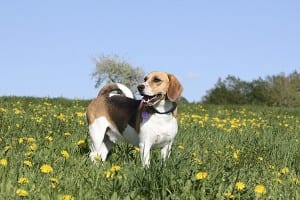
Beagle
The Beagle is amongst the dogs with best sense of smell.

A dog’s sense of smell far surpasses a human’s. But, have you ever wondered which breeds have the best sense of smell? Here is the top five breeds for detecting scents:

1. Most people would probably answer Bloodhound, famous from many movies and cartoons where they track scents for miles. A Bloodhound has 300 million scent receptors, which is far more than any other breed. These dogs can follow a scent on the ground, and also air scent. This is one of the oldest breeds that hunt by scent, and Bloodhounds are indeed used by law enforcement. Their work is so accurate that evidence trailed by Bloodhunds has been accepted in courts.

2. The Basset Hound is often considered the second best in scenting ability. These dogs are built to follow a scent trail, and have a phenomenal sense of smell.

3. The Beagle comes in as favorite on many types of dog breed lists, and they also have an excellent nose. These cheerful little dogs have as many scent receptors as the much larger German Shepherds, and can follow both air and ground scents. Beagles are often used as detector dogs for narcotics and agriculture. The USDA Beagles have a 90 percent success rate and can recognize around 50 distinct odors.

4. German Shepherds might not be the first breed that comes to mind when discussing sense of smell; they’re more known as police and military dogs. However, their keen sense of smell is one of the properties making them so well suited for these lines of work. They have around 225 million scent receptors and are excellent at air-scenting. That means that a German Shepherd can track a human scent carried by the wind. They are often used as tireless Search and Rescue dogs, bomb detectors, and narcotics trackers.

5. Labrador Retrievers also come to mind when talking about working dogs. Their sensitive noses made them great for Search and Rescue, drug, and bomb detection. Labradors are sometimes trained to detect cancer from a patient’s breath.

Looking for a dog breed that won’t shed?

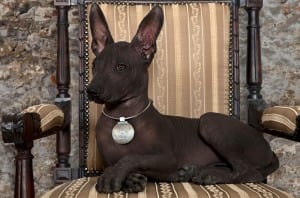
Xoloitzcuintli
While even “hairless” breeds technically shed to some extent, many breeds shed so little it’s virtually impossible to notice.

If you have a dog, he or she will shed. Surprisingly, this is true for many “hairless” breeds as well. When looking at a Chinese Crested or other hairless breed they don’t seem to have much to shed, but they still have some coat. If shedding is an issue for whatever reason, there are breeds that shed very little, and you might want to look into the dogs on our handy list.

Though the following breeds shed very little, many still require regular grooming.

The Yorkshire Terrier appears to have lot of hair to leave around the house, but they shed little. These are large dogs in small packages, and most of them love to explore. They’re generally curious, energetic, and have big personalities.

Another great little breed with big personality is the Border Terrier. They are affectionate, learn easily, active, and love to exercise. If you want a friend to bring on adventures, a Border Terrier might be your perfect companion.

Poodles are intelligent dogs and often battle the Border Collie for top position on lists with intelligent breeds. Poodles shed next to nothing, and are easier to handle than Border Collies, so this can be a great choice for someone wanting a smart companion.

The Bichon Frise is a cute and cheerful breed that sheds next to nothing. They’re small but harry, and love to be active and play. Many people allergic to other breeds do well with a Bichon Frise.

The wire-haired or smooth varieties of Dachshunds also shed little. They can be a bit stubborn, but have a convenient size, do well in apartments, and are fun and playful dogs.

On the somewhat larger side, the Portuguese Water Dog is known for being loyal and athletic. This is a breed that requires lots of exercise, and a Portuguese Water Dog can be a perfect companion for an active family.