Three myths about lost dogs

Lost dogs need help to get home to their families. If your dog wanders off, people might tell you some of these myths. It’s very important that you don’t believe them – keep looking for you dog! Some tips of what to do if your dog goes walkabout can be found here.

Myth One: Just wait for your dog to come home

Around 20 percent of lost dogs find their way back home, and it is a good idea to have someone at the house in case your pet shows up. However, the vast majority of lost dogs don’t come home on their own. That means you’ll never see him or her again if you don’t go out and look.

Myth Two: Old dogs go off to die

Old dogs wander off for many reasons. Intending to die alone is usually not one of them – lost old dogs who are found are generally extremely relieved to be found.

Elderly dogs often have diminished sight or hearing, they can be confused, have trouble with their balance, suffer a stroke, or have problems with their back legs and fall. They don’t mean to wander off any more than a human with dementia really means to leave home. If you have an older dog, always watch him or her.

Myth three: Your dog was killed by a Coyote

Over the past decade records on missing dogs show over 70 percent were found, and fewer than 3 percent were killed by coyotes. This myth is much more dangerous to dogs than any predator, because if people believe it, they stop looking. Almost any other explanation you can think of is more likely than your dog being killed by a Coyote.


Rescue dog tracks exotic species

Ten years ago black lab Tucker wandered the streets alone, afraid, and hungry. His prospects for the future were not bright; he was close to becoming one of the millions of homeless pets that die in shelters every year. Luckily for Tucker, he ended up with Conservation Canines, a unit of the University of Washington that employs dogs.

Tucker has an extraordinary sense of smell, and exemplary work ethic, and turned out to be very good at tracking scents so vague a human would never detect them. He has followed his handler all over the world, tracking Iguanas in the tropics, bats in old forests, and caribou in the arctic where he had to wear special boots and neoprene cape to withstand the cold. He can also track whales on light scents carried over water.

Tucker’s kennel mate Sadie went on a four month safari to Cambodia and helped determine how many tigers are left in two national forests.

Read more about Tucker in the Wall Street Journal

International Assistance Dog Week

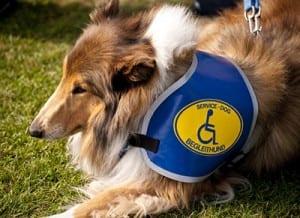
service dogThe International Assistance Dog Week is celebrated August 3 to August 9 2014. The event was created to celebrate all the devoted and hard working dogs that help individuals around the world every day.

The goals of the week is to recognize and honor assistance dogs, to raise awareness and educate, honor the trainers, and recognize heroic deeds performed by assistance dogs.

Assistance dogs can be pure bred or mutts. Many come from shelters. Regardless of size and color they all have one thing in common: they change the lives of their handlers and provide independence. They often make the difference between isolation and an active life. Examples of assistance dogs include Guide Dogs, Hearing dogs, and Service dogs.

These fantastic dogs can guide a blind handler safety through traffic, hear alarms, alert for seizures, and some are even trained to do household chores. They can learn to fetch items, pull a wheelchair, open and close doors, alert for high or low blood sugar, and a long number of other important tasks. Assistance dogs offer hope, dignity, and independence.

Don’t approach working dogs. Leave them alone to do their job. For company owners it is important to know that assistance dogs are allowed to accompany their humans to all places open to the general public – including restaurants and shops. While an assistance dog can wear an identifying vest, this is not a requirement.

To learn more about this week, visit assistancedogweek.org

Sunshine story: Rescued bulldog saves her new human dad

Bunny is a friendly bulldog who was found wandering along the highway. Skinny as a stick and riddled with ear and eye infections she certainly needed help, and Will and Cindy Sherman rose to the occasion. Bunny got good food, vaccines, toys, and checkups.

When Bunny developed a cough related to her heart worm treatment, Will took her back to the vet. She got a steroid shot and they returned to the car – where the world went black.

Bunny bolted to the vet’s office and barked and scratched at the door until the receptionist opened – and saw Will convulsing with half his body in the car.

Luckily, help was close. People streamed out of the office – including an EMT who knew what to do.

Thanks to Bunny’s swift intervention, Will could be rushed to the hospital, and the attack was diagnosed as a grand mal seizure. These are caused by an abnormal electrical activity in the brain, most often triggered by epilepsy, but also by low blood sugar, high fever, or a stroke. Many people who have a grand mal seizure will never have another one. Nothing like that ever happened to Will before, and he hasn’t had another seizure since.

Doctors say that if help hadn’t arrived so quickly, the outcome come have been very bad. Luckily, Bunny was there, and repaid her rescuer in a way no one could have anticipated.

Fun facts about dogs

Love dogs? Here are some fun facts about dogs you might not know.

Ever wonder why you can’t outrun your dog even on the best of days? The average dog can run around 19 mph. The Greyhound is generally considered the fastest dog breed, and they can reach speeds of 45 mph over shorter distances. When it comes to long-distance running, the Saluki is the fastest. They “only” run 43 mph, but they can keep that up for miles.

Smaller, but super-quick, the Whippet is also amongst the top speeding dogs. A Whippet can run 200 yards in 12 seconds.

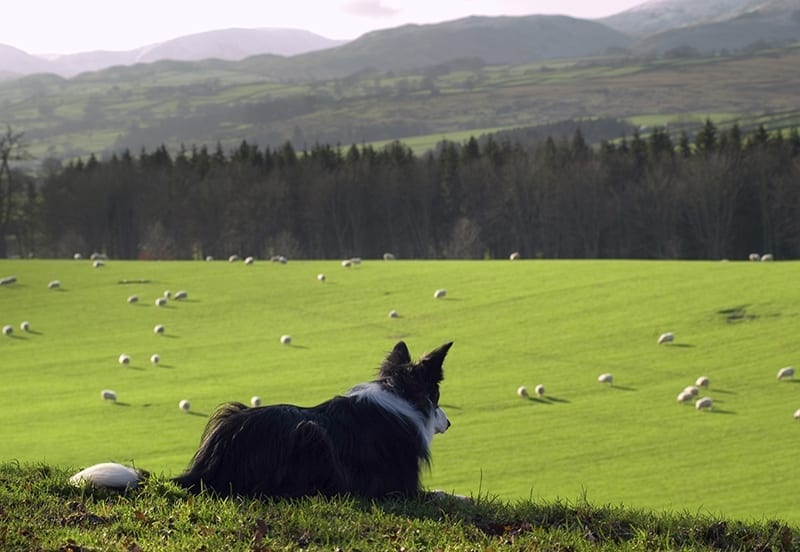
The Border Collie might not be a breed many associate with speed, but they have physical abilities to match the role of super-smart workaholic. These dogs can make hairpin turns, keep control and speed while throwing themselves into a new direction, and keep a pace of 30 mph. A herding Border Collie can easily run 50 miles in a day.

Dogs aren’t just fast when it comes to running – an average dog can locate the source of a sound in 6/100ths of a second. They also hear a larger range of frequencies than a human, and are estimated to hear about four times better than humans. Many dogs dislike loud noises – if it’s loud to us, it’s really loud to them.

Many dog owners claim their dogs speak to them. Dogs can indeed show emotions through their face, and have around 100 different facial expressions to accompany a long row of different vocal sounds.

Border Collie

Ideas for finding pet-friendly living

There are many health benefits to petsIn many parts of the USA it can be difficult to find a pet-friendly rental. Many landlords have lists of breeds not welcome, and some limit the number or size of pets. While arguing with centrally mandated policies is a waste of time and energy, there are other things a family can do to find a perfect rental to accommodate even the furry family members.

Plan ahead

The rules for giving notice and time-frames for finding somewhere to move will vary from state to state. Make sure you know what’s mandated and what’s considered good form where you live, and start looking for your new home ahead of time. You might have to call many landlords before you find the right one. Be polite, and ask about pet policies.

Questions to ask can include:

  • Whether they have a ban on specific breeds or sizes
  • Is there a pet security deposit? If yes, is it per pet or per rental unit, and is it refundable?
  • Is there a pet fee on the rent?

Consider a private rental

Many apartment complexes have policies the on-site crew can’t change. They might also think it’s silly you can’t bring your big dog, but it’s out of their hands and arguing won’t help. It’s often easier to find an individual homeowner who wants to rent their house, and who will welcome your pets.

Check online listings – most of the larger home-search sites like Trulia and Zillow have a rental section – and keep an eye on newspaper listings. Also tell your friends on Facebook that you’re looking. Word of mouth is powerful, and someone might just know someone looking for a tenant.

Many real estate companies manage rentals for their clients, and the real estate agents might own properties they rent out. Check their websites and give them a call. They might say no, which isn’t the end of the world, or they might say yes.

If you still can’t find something, ask for help. The local humane society might know of pet-friendly landlords. Some counties also have lists, or can give suggestions.

Have all papers in order

You might need to show proof of vaccinations and vet visits. Certifications or other documentation  can also help sway a hesitant landlord.

Ideas of documents to show to prove how good your doggie is include:

  • Canine Good Citizen Certification
  • Contest wins
  • Diploma from an obedience class
  • Letter of reference from your current landlord

When you go look at a rental, show pictures of your well-groomed and cute pets. If you find a place you really want but the landlord seems hesitant when it comes to your pets, ask if you can introduce them in your home. That’s a great opportunity to show how adorable and well behaved your dogs are, and how well you take care of your home.

Put everything in writing

When you’ve found the perfect place and gotten approval from your new property manager or landlord, get it in writing. Most commercial properties have a pet addendum that will be signed by both parties and added to the contract.

Last but not least, don’t give up.


Sunshine story; dog changes homeless man’s life

John Dolan’s drawings sell for around $7,000 in a London art gallery. Most of them are pictures of his dog, George. The two are inseparable, and currently prepare for an art show in Los Angeles.

It hasn’t always been like that. Not long ago, John Dolan lived on the streets of London, homeless and wondering where to get his next meal. A homeless woman traded a beer can for a puppy, and gave the dog to John who started to draw his new best friend.

After that, everything changed. People passing on the street bought the sketches, and John and George soon caught the eye of a gallery owner. Now, John is writing a book about his dog, and he’s working on a set of drawings of rock stars with their dogs.

To read more about John and George, visit today.com.


Dogs can get jealous

Many dog owners are convinced their dogs get jealous, while some people say it’s just imagination – projecting a human emotion on the dog. Scientists recently made an experiment to ascertain which is correct.

The test adapted a test used for human babies. 36 dogs and their families participated, and the owners were asked to shower a robotic stuffed dog with affection, pay attention to a plastic jack-o-lantern pail as if it were a dog, and to read a book aloud. The pail and the book were compared to the robotic dog to see if there’s a difference in behavior between something that looks and acts like a dog – the robot barked and wagged its tail – and something that’s clearly not.

To make the experiment fair, the robot would have to be lifelike enough to be accepted as an actual dog. 86 percent of the participating pooches attempted to greet it like they would a dog, and were probably surprised when the rear end held no smell…

The results were clear. The dogs were twice as likely to touch or push their owner when he or she paid attention to the robodog than when playing with pail. A full 78 percent pushed and touched in response to the impostor dog. 42 percent reacted that way with the jack-o-lantern, and 22 percent when their human read the book.

It becomes even more interesting. One fourth of dogs snapped at the robot, and one third tried to place themselves between the robot and their owner.

Conclusion? Dogs definitely get jealous. It’s not your imagination.

Why do some dogs love to have their tummies rubbed?

Some types of doggie behavior can be puzzling to us humans. Like, what’s up with the tummy rub? And why are dogs so fascinated with sniffing each other’s butts? 

The belly scratch

Not all dogs like to have their bellies rubbed, but many of those who do really cherish it. There are several theories to why.

Dogs generally don’t show their stomach to other dogs – unless in a sign of submission – and assuming they don’t do it of fear, showing their tummies to us shows trust. The tummy rub becomes a way of bonding.

On top of this, the stomach can be difficult to reach with the paws, and the skin there is sensitive. A good tummy rub with human fingers probably feels better than their own nails.

The butt smelling

If a human was to approach from behind and smell another person’s butt we’d find it peculiar to say the least. In the doggie world, this approach avoids challenging someone by facing them head-on. The tail-end of the dog also gives off pheromones that can be read by other dogs. By sniffing the behind, a dog can learn about sex, reproductive, and social status.


Rescue dogs saves baby

There are many stories of rescue dogs repaying their families in unexpected ways. Duke was adopted six years ago, and his family says he is a perfect dog, meant to be theirs. They didn’t anticipate him becoming their hero in more ways than providing love and company.

Duke is normally calm and obedient, and looks like a cautious boy on the news video. No wonder his family was alarmed when he rushed into the bedroom and jumped up on the bed, shaking.

His behavior was so uncharacteristic that the family went to investigate, and found their baby not breathing. Thanks to Duke the child was discovered in time and could be saved.

The family hopes many will see the video and decide to adopt. You never know when the life you save may return the favor.

https://www.youtube.com/watch?v=BQvzKk9Tn0s

Five of the world’s largest dog breeds

Many like small dog breeds, because they are convenient. A small dog doesn’t require as much space as a big dog, smaller dogs eat less than big ones, and so on. But, there is something special about the gigantic dogs, like Newfoundlands, Irish Wolfhounds, and Mastiffs. Here is a list with five of the world’s largest dog breeds.

The Irish Wolfhound
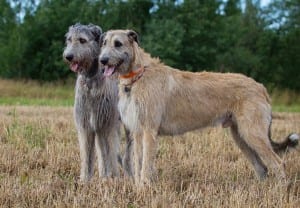
An Irish Wolfhound requires an extra large PlexiDor dog doorThis is a friendly giant. The breed is not currently record holder for world’s tallest dog, but if one were to take an average of individuals in a breed they would be the tallest. They are excessively friendly towards people and don’t do good jobs as guard dogs. If a burglar were to enter the house and carry off some things the Irish Wolfhound would probably consider the intruder a new best friend. However, if the family is physically attacked, an Irish Wolfhound will defend its people.

They are patient and generally good with children. While they take to urban living pretty well, they require a lot of exercise.

The Great Dane

A Great Dane needs an extra large dog door
A Great Dane currently holds the position of world’s tallest dog. They are generally very friendly and get along with people, other dogs, and other types of pets. Great Danes are strong, elegant, friendly, and energetic. The earliest drawings resembling the breed stem back to around 3,000 BC, and the oldest written description of them can be found in literature of 1121 BC.

The English Mastiff
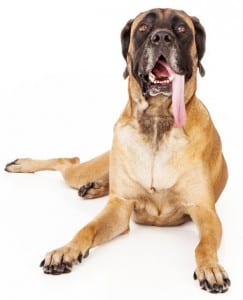
An English Mastiff requires an extra large PlexiDor dog doorThe Great Dane and Irish Wolfhound might compete about being the tallest dogs on the planet, but the English Mastiff is definitely the heaviest. A male can weigh up to 250 lbs, and the breed is considered the oldest in the UK.

English Mastiffs make wonderful and devoted pets. They are generally very good with children and other dogs, but they tend to be lazy and needs to be activated in order to get enough exercise.

The Leonberger
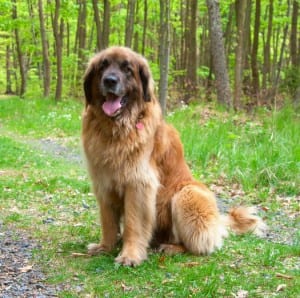
A Leonberger requires an extra large PlexiDor dog door.The Leonberger is extremely popular in Europe, maybe a bit less so in the USA. They are even-tempered, unfazed by most things, and become deeply attached to their humans. They are also very agile for their size, and require lots of exercise.

Leonbergers can be very energetic when they grow up, but generally settle down around the age of three and becomes gentle giants.

The Scottish Deerhound
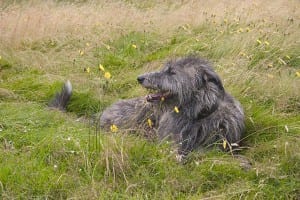
A Scottish Deerhound requires an extra large PlexiDor dog doorThis is the least commonly known breed on the list, and looks somewhat like a long-haired greyhound. The history of the breed has been traced back to pre-Roman times, and they are very popular in their home country.

A Scottish Deerhound is about the friendliest animal on the planet. They are eager to please, gentle, and loving. However, they get bored easily and require plenty of exercise and something to do. They are happiest in pairs, and keeping two together can alleviate many of the boredom problems.


Can a giant dog have a dog door?

Absolutely. There is a PlexiDor dog door for even very big dogs.

The extra large PlexiDor is constructed to stand up to these large and powerful dogs, even if they go through the door at a full run. The dog door handles dogs approximately up to 220 lbs. If you’re in doubt, contact customer service and they will be happy to help you pick the right solution for your needs

Hero dog rescues deaf 13-year old from fire

Ace is a 2.5 year old Indianapolis Pit Bull who recently saved his best friend – 13-year-old Nick Lamb – from a house fire. Nick is deaf since birth and was sound asleep when Ace woke him up. Naturally, Nick didn’t want to get up, but Ace persisted. As soon as Nick was properly awake, he realized the house was filled with smoke.

Both the boy and the dog made it out without injury, and firefighters were able to rescue the family’s cat as well. Kitty had to visit the vet to treat her smoke inhalation but she is expected to recover.

Without Ace, it is likely that Nick would never have woken up, and he would have perished in the blaze.

The house turned to rubble, but thanks to Ace, the family is still complete.

Adventurous dog rescued from roof

Bucky is an adventurous poodle mix who recently spent an afternoon on the roof. He climbed out through an upstairs window with town screen, and walked back and forth on the edge of the roof for at least half an hour, dangerously far above the ground.

Getting back into the house wasn’t as easy as getting out; every time he went back to the window his friend Bear – a mastiff – stuck his head out to see what was going on.

Bucky’s family was away, and the neighbors ended up calling 911. Firefighters brought a ladder-truck to rescue the daring poodle, but he didn’t want to go with them. Eventually, the treats became too tempting, and he got close enough for one of the firefighters to grab him.

Police dog sniffing out computer hardware

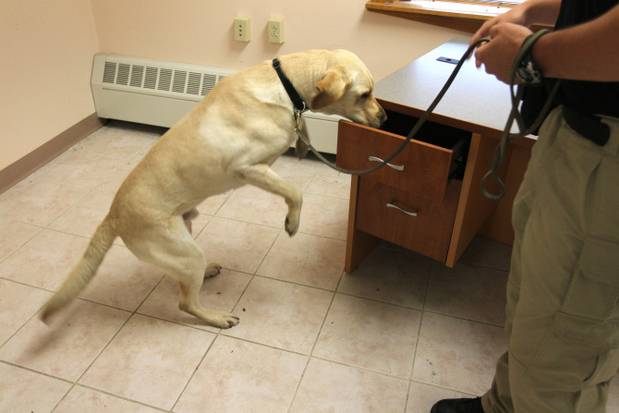
Dogs help law enforcement in many different ways, but few would have predicted the talent golden labrador Thoreau uses in his service to the Rhode Island state police. Thoreau has been taught to sniff out hard drives, flash drives, and other computer components.

This is of value to the police in the fight against child pornography. Storage devices with evidence are small enough to be hidden in places where the officers can’t find them, which allows child pornographer to go free. Thoreau can join in on a search warrant and find object impossible for a human to detect.

Thoreau is new on the job after five months of specialized training, and has already helped secure an arrest warrant. He found a flash drive with child porn stashed deep inside a metal filing cabinet.

The four-legged crime fighter was trained in Connecticut at a program that currently trains over 60 dogs in different types of detection work.

Thoreau is a computer hardware detector dog
Image from providence journal.com

Arlington police officer saves pit bull – twice

About a month ago, Arlington Sergeant Gary Carter responded to a call of a vicious dog trotting down the road. He found a pit bull wandering along the road, but the dog was anything but vicious; he was lost and trying to make friends.

Carter picked up the dog and brought it to animal services, who reunited him with his owner. A photo of Carter with the dog was posted on the police department’s Facebook page and went viral – it has been seen over 12 million times. After that, Carter didn’t think he’d ever see Jeffrey the dog again.

A few days ago, Jeffrey snuck out of his yard again, and ended up with Arlington Animal Services, again. This time the owner didn’t bail him out, and Jeffrey was stuck at a shelter overflowing with animals. That meant he had days to find a new home, or he would be euthanized.

When Carter heard that Jeffrey was back, and what a pickle he was in, he went to the shelter to take some photos, thinking he could help Jeffrey find a home. It didn’t turn out like that: he adopted the dog instead.

https://www.youtube.com/watch?v=5fwRAW7tCKY